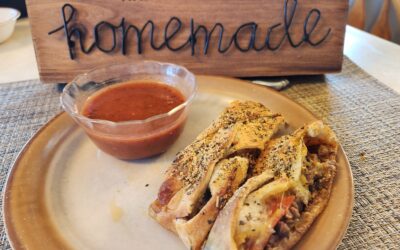
Recipe | Beefy Mexican Lasagna

For Beef Month, I want to share one of my favorite BEEF recipes: Beefy Mexican Lasagna. This recipe is an easy, kid-friendly dish that I use often. It is from the Healthy Beef Cookbook, by the National Cattlemen’s Beef Association and American Dietetic Association.

Enjoy!

Beefy Mexican Lasagna

Prep Time: 10 minutes

Cook Time: 35 minutes

Total Time: 45 minutes

Beefy Mexican Lasagna

*Can be made up to 24 hours ahead and refrigerated. Increase baking time to 45 minutes.

*Recipe from The Healthy Beef Cookbook, by the National Cattlemen’s Beef Association and American Dietetic Association.

Ingredients

  • 1 ½ pounds 95% lean hamburger
  • 2 cans (10 oz. each) mild enchilada sauce
  • 1 can (15 ounces) black beans, rinsed and drained
  • 1 ½ cups frozen corn
  • 1 teaspoon ground cumin
  • 9 corn tortillas
  • 1 ½ cups shredded Mexican cheese blend
  • ½ cup chopped tomato
  • 2 tablespoons chopped tomatoes
  • Crunchy tortilla strips (optional)

Instructions

  1. Heat oven to 350 degrees.
  2. Brown ground beef in large nonstick skillet over medium heat 8 to 10 minutes or until beef is no longer pink, breaking up into ¾ inch crumbles. Pour off drippings.
  3. Stir in 1 can enchilada sauce, black beans, corn and cumin; bring to a boil.
  4. Reduce heat; simmer 5 minutes, stirring occasionally.
  5. Spray 11 ¾ x 7 ½ inch glass baking dish with nonstick cooking spray. Arrange 3 tortillas in dish, cutting 1 as needed to cover bottom.
  6. Spread ¼ cup remaining enchilada sauce over tortillas; cover with one third of the beef mixture, then one third of the cheese. Repeat layers twice, omitting final cheese layer.
  7. Pour remaining enchilada sauce over top.
  8. Cover with aluminum foil. Bake in 350 degree oven 30 minutes.
  9. Remove foil; sprinkle with remaining ½ cup cheese. Bake, uncovered, 5 minutes or until cheese is melted.
  10. Top with tortilla strips, if desired, tomato and cilantro.
Schema/Recipe SEO Data Markup by ZipList Recipe Plugin
http://commongroundnebraska.com/recipe-beefy-mexican-lasagna-2/

Mom of Agriculture – An Open Letter for Mother’s Day

Kaydee Caldwell and her mom, Dawn, at their ranch in north central Kansas.

Dear Food-Loving Americans,

I want to tell you about someone who helps put food on your table — my mom. My mom doesn’t just feed our family, she helps feed approximately 120 additional people between the beef we raise and crops we grow on my family’s farm. So today, in honor of Mother’s Day, I’d like to share why I am so proud to be the daughter of Dawn Caldwell.

My brother, Emmett, and I were exposed to agriculture VERY early in life, and I am proud of that. The reason we were exposed to agriculture, aside from growing up on a farm, is because of my mom. My mom is not like other moms. Sure, she cooks and cleans, she takes care of all of the housework, takes care of us kids, but when she goes out, she is what I like to call the “mom of agriculture.”

Let me explain what this means. In addition to her job off of the farm and taking care of our land and animals, mom is a volunteer for the program called CommonGround. This means she goes out and talks to people, usually from cities, who are confused about the food choices they are making. For example, someone might have questions about popular food issues like antibiotics in meat or GMO corn, and my mom will help answer those questions. When I go with her, I see how she talks to the people — she is just very open, and they can ask her any question. Most importantly, she is honest. Watching her is like watching a superhero. BAM, BAM, BAM! Answer. Answer. Answer. The reason she is like that is because everything she shares is the truth. She knows it. She has done all of her own research and mixes it with what we do on our farm. I have to admit, if she wouldn’t have started talking to moms about food and where it comes from, I wouldn’t be talking to kids my own age about the same issues.

Just watching her talk and “agvocate” makes me understand and appreciate what we do as a farm family. She is proactive and inspiring, and I am really proud of her. While my mom can sometimes be over the top, without her showing me how to talk to people about agriculture, it would have never been possible for me. She is really setting my brother and I up at a young age to be true leaders and true members of society, to really get something done for the world.

You don’t really hear about a whole lot of women going out and doing something huge like CommonGround. You never really see a woman speak for agriculture the way she does. And, if you do, people just think, “Oh, yeah, that’s a farm wife working under her husband.” No, this is my mom, Dawn Caldwell, 100 percent. There is no one telling her what to do. She is doing what she thinks is right, and she is making a huge difference – not just with our family, but also with agriculture. Thanks to her, there are a lot more people becoming knowledgeable about what is on their plate and how it got there.

If I had to choose just five words to best describe my mom, I would say: The very best mom ever!

Happy Mother’s Day! You are my biggest role model, and I love you!

– Kaydee Caldwell, 16

Kaydee Caldwell is the daughter of CommonGround Nebraska volunteer, Dawn Caldwell.  You can learn more about Dawn and her family’s farm by following her blog at www.ladyofag.wordpress.com or on Twitter – @ladyofag

Video | Planting corn with my “helpers”

We have been busy planting corn in Nebraska, but I wanted to take a few minutes to explain a little bit about the equipment we use and the cool technology. We use precision planting software that helps drive the tractor to keep planting accurate.

Also, you’ll see something new in the tractor cab….I bet some of you didn’t think an iPad could be used with farming!

Enjoy this video of planting with me and my “helpers”.

Mama Cows Know Best

We are in the thick of calving. Last weekend, severe storms were predicted for our area. This always means checking cows more often. Weather fronts tend to put cows into labor. Saturday morning I found three new calves, all up and frolicking when I checked them. A storm moved through right after dinner so the girls and I did another walk-thru to make sure everyone was content.

We counted one calf missing, one that had been born that morning. However, I have learned most cows are great mothers. And they will let you know by their behavior if their calf is truly missing. All cows were just watching us and chewing their cud. Hmmm…

We looked around the perimeter of the cow yard but didn’t turn up any missing calf. I kept an eye on the cow I knew had calved that morning but didn’t have a calf beside her. She is just watching us, not giving us any indication of where she might have tucked her calf. She’s good. She’s experienced at this calf raising deal. Another round of rain was starting so we headed back to the house.

Again, we headed out after the latest weather passed. This time we took a wider path around the outside of the cow yard. We searched in the tall alfalfa, in ravines and in amongst shrubs and downed trees. Again, I watched the cow. She started ambling toward the northwest where K was searching. Sure enough, K lets out a shout. She had found the calf tucked in deep under a thicket. He was warm and dry in there. Mama had sent him under the electric fence and watched him hunker down before any of the nasty weather had started. She wasn’t worried.

A city-girl, now ranch-girl talks beef

Since May is celebrated as Beef Month, I wanted to share about a beefy-opportunity I had to speak alongside volunteer, Joan Ruskamp, to a group of chefs in Omaha.

It was important for the chefs to know about our animal care practices, doctoring cattle and ensuring animal health They get questions from their customers about the beef, so hearing from Joan and I about beef production brought the story full-circle. Since my husband and I raise cows and calves, I was able to talk about our breeding operation, where Joan was able to talk about her beef feedlot – a similar place to where our calves go after they are weaned from the mama cows.

Enjoy my presentation, or click here to watch it on YouTube!

Suits & Boots

At first glance, what do you think are the occupations of the gentlemen in this picture? Maybe business executives? Accountants? Professional communicators? Health care professionals? Or, maybe owners of multi-faceted businesses??  And, where do you think they might be from?

Actually, these men hold each and every one of those jobs listed above, along with many more depending on the daily task at hand. How can that be you ask?  Because a farmer or rancher has to be able to do any one of those jobs on any given day. And, they happen to be from different states, all across our great nation.

When any of us head into the grocery store or out to the restaurant, or even to the farmer’s market, it is not uncommon to at least have a fleeting thought about some of the production work that went into growing the food that is there.

What many people often don’t think about is all of the work farmers and ranchers have to do off of the farm in order to have the freedom to continue doing what they love to do. Some days they may visit their banker or insurance agent. Other days can be filled with purchasing supplies and inputs. But why on earth would ranchers be standing around at a meeing in suits? Aren’t they more commonly seen in jeans & boots? Of course they are!

Last month I was in Washington, D.C. with other beef producers discussing the beef community’s challenges and opportunities at hand. Think about teachers or health professionals or country music performers. Each profession has an organization for people with similar interests. In today’s world, those of us raising cattle for beef cannot stand idly by and let others determine our fate. We have to step off the ranch or feedyard – in our boots -

- and educate others as to what really needs to happen to keep healthy, safe, nutritious beef as an everyday meal option.

It is completely my honor to serve with absolutely “stand-up” men and women from all over the U.S. with as much passion as I have for beef and the entire beef community.

My passion for ag goes way back

Hi! I’m Dawn Kucera from Madison, Nebraska. I originated from northeast Iowa where I grew up on my family’s diversified livestock and crop farm, but now farm and ranch with my husband in Nebraska where we raise corn, soybeans and alfalfa.  We also run 40 Angus beef cows and feed out our calves.  The majority of our beef is retailed directly to consumers from the farm.  My husband, Regan, also sells seed corn and operates a crop consulting business.

My daily routine is very diversified.  I take care of all aspects of our beef operation.  My daily duties include feeding, checking cows, and marketing our beef.  I also take care of our other livestock chores.  I manage the bookwork for our farm and well as our seed and consulting businesses.  During planting and harvest, I do help in the field, driving tractor as needed.

My passion for agriculture goes way back to my years growing up in Iowa.  I am so proud of my family’s agricultural heritage.  I realize the need to make sure that the general public, and my family, never takes their food supply for granted.  I know the knowledge of agriculture in the urban population is declining fast.  Even though we live in the “heart of agriculture”, that lack of knowledge is also right here.  It is important that consumers put a face with their food.  I have seen that firsthand with our beef sales.  I want to take advantage of the opportunity to promote the industry that is the lifeblood of my family.

3 Things I Learned at a MegaChurch on Earth Day

This past weekend on an out of town trip we decided to attend a megachurch. The kids were wowed by the TV cameras. I was wowed by the music. Then the lights went low and the sermon began. Who would guess they would talk about farming? And that we were probably the only farmers sitting in the sanctuary?

Here are three things I learned:

1. I learned that people are being taught that farmers today don’t have a connection to the land and instead are intent on destroying it. I was one of few in the congregation who caught the pastor’s reference to “monocultural farming” saying growing one crop is sinful and that “God delights in diversity”.

This pastor doesn’t know that farmers do nurture the land. That’s why we till it as little as possible to let the residue from past crops hold in the moisture and nutrients. That’s why Tom gets out of the tractior ten times a day to kneel down to check how deep the seed is being planted and what the condition of the soil is.

As for diversity, we’ve got 1000’s of different foods in grocery stores. Just like other countries depend on rice, ours depends on corn, soybeans, sorghum and wheat staples. It’s not evil. It’s feeding people.

2. I learned that some people think we are one with the earth. We are made from dust and to dust we’ll return, you know. “We are part of it and it is part of us” I have in my notes from the sermon. Some people take the verse -“How majestic is your name in all the earth” literally. This pastor said it was man who destroyed the world with his evil before the flood. The land takes on a spiritual quality in these people’s minds.

I agree God made the world and all that is in it yet it is still humankind that he promises heaven to. We love our land and our lives are centered on enriching the soil for future generations. Still, buckets of it are not sitting at the table with us at Christmastime.

3. I learned that it is taught in some churches that a garden in an urban area is a literal picture of heaven. This pastor taught that since there will be a Tree of Life in the new Jerusalem, putting in a garden is putting heaven on earth. This guy can plant all the gardens he wants. He is not going to make a heaven on earth. A nicely weeded garden is a beautiful thing to behold but it’s not heaven.

Earth Day means a lot of different things to a lot of people. Now I know that for some people Earth Day is almost right up there with Christmas and Easter. We’ll be back to our mini church this Sunday led by a pastor who puts people in God’s world first rather than elevating God’s world to people status.

We’re just animal people

We recently invested in a small, 3 sided shed. An investment that will provide large returns on our original investment. Not the kind of returns a banker or accountant might calculate (although you never know!). We’re investing in our children and their futures.

If you drove by our place, you might wonder why in the world would we get a shed for livestock – there’s a feedyard right across the road! Well… while someday our kids may have responsibilities at the feedyard, they can’t operate a feedtruck or a chute, so there’s not much they can do but watch or ride along (which they love to do).

Our plan with this shed is to have a small amount of livestock at our house, so that we have a “project” close by that our kids will have associated responsibilities. Chores.Something every kid needs (not necessarily animal related, but some sort of chores). And because we’re just animal people. Not the kind that have pets on their laps and treat them like children (although we love our pets), but the kind that love caring for livestock. We want to pass that love of livestock on to our kids. And truth be told… I want to have some livestock at our place to care for.

That’s how it works. Kids learn how animals behave and how to care for them by watching their parents (or someone else). And they learn about responsibility. I remember when I was a kid (don’t you wish you had a dollar for every time you’ve heard that) on Saturday morning when I wanted to stay in pjs and watch cartoons… but our 4-H cattle needed to be fed. We didn’t eat until they ate.

For non-farm consumers, this probably doesn’t make much sense. It might not even make sense to our fellow farmers who aren’t livestock producers! The reason I share this is to provide an example of how we learn about what we, as livestock producers, do… and that we do it because we are animal people.

Although we aren’t starting a project that we expect to be a big money maker, we’re starting a project we believe to be much more important to the future.

Farm for the future

CommonGround Nebraska volunteer, Hilary Maricle, was in the MIdwest Producer with her family and we wanted to share about her family farm. Enjoy!

Maricle Family Farms is truly a family operation, clear back to the 1870s when two quarter sections were homesteaded between Albion and St. Edward, just east of the Sand Hills in northeast Nebraska.

Add an 80-acre timber claim and a dugout home and the family was well established in Boone County. Now that farm fronts Nebraska Highway 39 that connects the two towns and the Maricle names remain as owners and operators, nearly 150 years later.

Brian (@mariclebeef on Twitter) and Hilary (@mariclefarm on Twitter) Maricle, and their five children, are the youngest family on the farm now. Legally, Maricle Family Farms is an arrangement between Brian’s parents and grandparents. The farm supports three generations, with two of them actively working.

The generational transfer is something they said needs to be addressed, since Brian’s parents, Keith and Mary Ann, turn 60 this year.

“Our goal is to keep what is there and take ours and put it together,” Hilary said. “Will we transition quick enough for Austin to come back after college? Austin may not want to, but will we have enough for the twins (Cody and Carson)?

“I’m thinking how will we get our kids in, and we aren’t in yet.”

Austin is 14 and Carson and Cody are 8. The three boys have two girls, Cassidy, 5, and Kate, 2. They all take active roles in the family operation.

“The only way to get the next generation to farm is to have them sit beside you,” Brian said. “They have to breathe it. We’re not stuck in gender roles. My sisters worked with the cows. We expect the girls to do everything the boys can do.”

One afternoon each week, they forego the babysitter and Brian plans a day so they can help as much as their ages allow. It’s no surprise that the Maricles farm.

Hilary’s grandparents farmed. Though her parents, Bob and Patty Esch, ran the grocery store in Spalding, Neb., she grew up on her dad’s farm and showed cattle with her mom’s family, the Valaseks. She loved being in 4-H.

“I had a passion, getting to learn more about ag, and not just cattle,” she said. “In the big picture, I knew I wanted to be in ag.” She attended the University of Nebraska-Lincoln, with emphasis in the animal science program. She earned bachelor’s and master’s degrees, with a focus on adult education.

After graduation, she filled a short-term position in the ag program at Boone Central High School in Albion, then answered a call to build an ag program back home in Spalding. She filled a teaching adjunct position for several years at Northeast Community College, then became a full-time faculty member at the Norfolk college in the fall of 2009. She teaches agribusiness classes, including recordkeeping. Her grocery story background helps with farm-to-fork instruction. She also is in charge of the ag internship program.

Brian also graduated with a bachelor’s degree from UNL and returned home to farm.
“I know not many my age came home,” he acknowledged. Actually, his parents didn’t come home right away either. His dad has an accounting degree.

“He hadn’t planned to farm, but finally realized that’s what he was going to do,” Brian said. His parents moved to the farm from Kansas City in 1979. Gordon and Irene Maricle, Brian’s grandparents, met at UNL and moved to the farm in 1949.

The farm had a Grade A Holstein dairy from 1952 to 2003, building a new milking parlor in 1993. ”When my youngest sister went to college, the cows left, too,” he said.

A Simmental-Angus beef cow herd was started in 2000, building to 120 cows in 12 years. The herd is pastured in Boone and Greeley Counties. Hilary said the three-year overlap of the dairy and beef herds “made us better beef producers.” They used to feed out the calves but Brian said it takes so much capital with the high price of feed. ”We sell all our calves now. It’s weird to not have them,” Hilary said.

Brian said he loves calving season and harvest, but misses haying. When they sold the dairy herd, they also got out of the haying business. They have been finishing 1,500 hogs a year. In recent years, Cargill lined up a supplier of feeder pigs, but the ownership changed. “So we’re in limbo,” Brian said. “We’re trying hard, but this hog thing is crazy. Hogs are over $80 and we’ve never paid over 60.

“We’re in a whole new level of commodities. It takes so much more to do things.”
Hilary said, “If the dollars and cents don’t work out, we’ll have an empty barn.” Closing the dairy, no longer feeding calves and possibly losing their hog business isn’t what the Maricles desire. ”I want to be a diversified farm, so we’ll always make a little money but not a lot,” Brian said.

They continue to raise corn and soybeans. In spring 2008, Brian and Hilary bought a half section of land near Spalding, with the help of the Beginning Farmer program. Together, Brian and his dad have 800 acres of cropland.

All told, the Maricles hope to have enough for the next generation.  ”When we had the calves, the boys handled the gates and they hated it,” Brian recalled, “but one week after they were gone, they missed it.”

Said Hilary, “It’s fun watching the kids get excited about it.”